

Featurette: Write-Along, the Anatomy of a Story
I've documented my process in real-time as I craft a short story of 2500+ words from start to finish.

Introduction
I find the processes that authors produce/generate their craft to be an amazing insight into psychology, systems, and more.
This week, I thought I’d share mine, since I often get asked how I come up with the things that I write. Come along with me from a blank slate to a finished narrative that meets my requirements.
Here’s the raw and final draft, complete with history. Return to Earth: A Dark Comedy
In the beginning
Friday, April 10th 2026
It is another Friday and that means it’s time for my weekly generative writing.
The first thing I do is check my inbox. Two emails:
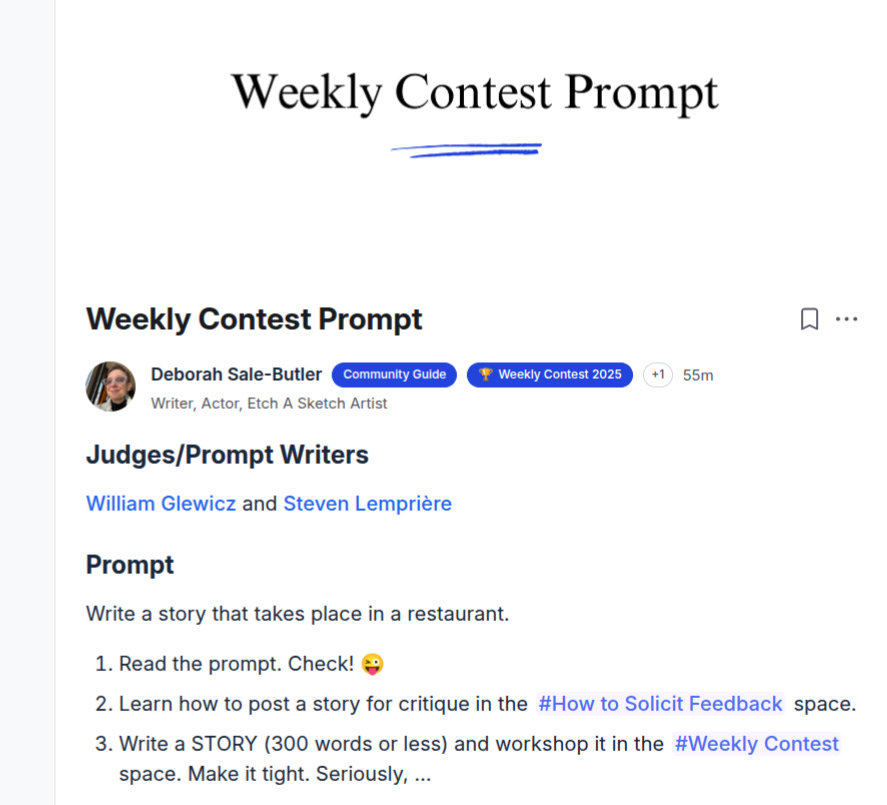
A prompt for 300 word max. The Authors only Collective
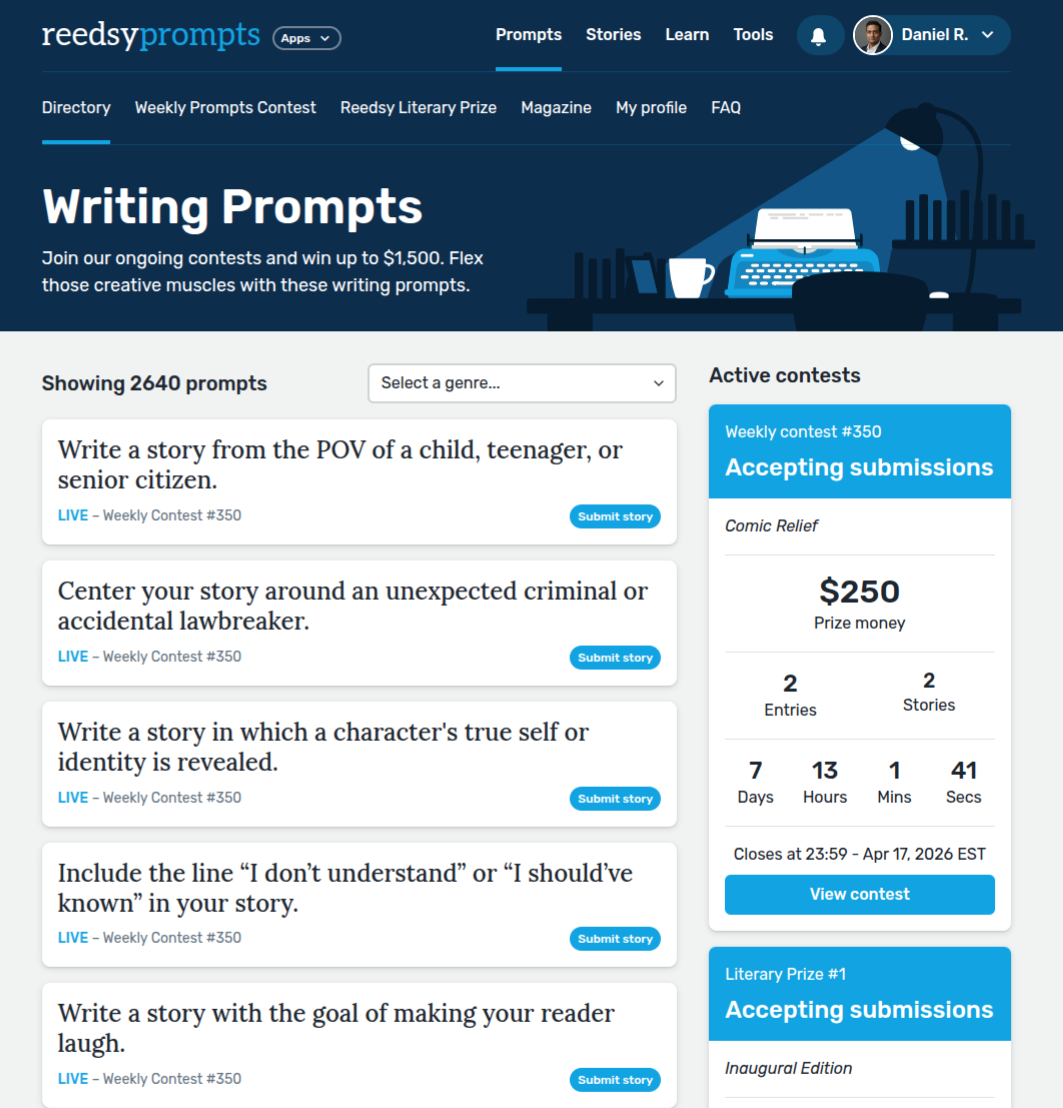
A set of 5 prompts up to 3000 words max. Reedsy Prompts
Mood check: Before I decide between a cap of 300 or 3000, I need to ask myself how I’m feeling. Today, I’m physically sluggish from a 90-minute drive from Sacramento to Sausalito for a public preview of “The Chaos Particle.”
My physical state puts me at a disadvantage from the start. The good news is I’m not depressed—-so the story won’t be grim.
Let’s see what the prompts are:
Write a story that takes place in a restaurant. (AOC)
Write a story with the goal of making your reader laugh (Reedsy)
Include the line “I don’t understand” or “I should’ve known” in your story. (Reedsy)
Write a story in which a character’s true self or identity is revealed. (Reedsy)
Center your story around an unexpected criminal or accidental lawbreaker. (Reedsy)
Write a story from the POV of a child, teenager, or senior citizen. (Reedsy)
This week’s prompts dive into the funny and the unexpected. Include a grand reveal, a surprise twist, or an unforgettable moment that’ll leave our judges howling with laughter. Do you have a story within you that can stop us in our tracks? –Reedsy
300 words about a restaurant seems super easy, but I want to laugh, so I’ll go with #3: Include the line “I don’t understand” or “I should’ve known” in your story.
When it comes to Reedsy Prompts, you’ll notice 5 options. I take one strong option and incorporate all 5 prompts when I can. This gives me a single story to put into five categories if I feel competitive. Most of the time, these stories are for my own amusement.
Topic picked—Let’s begin:
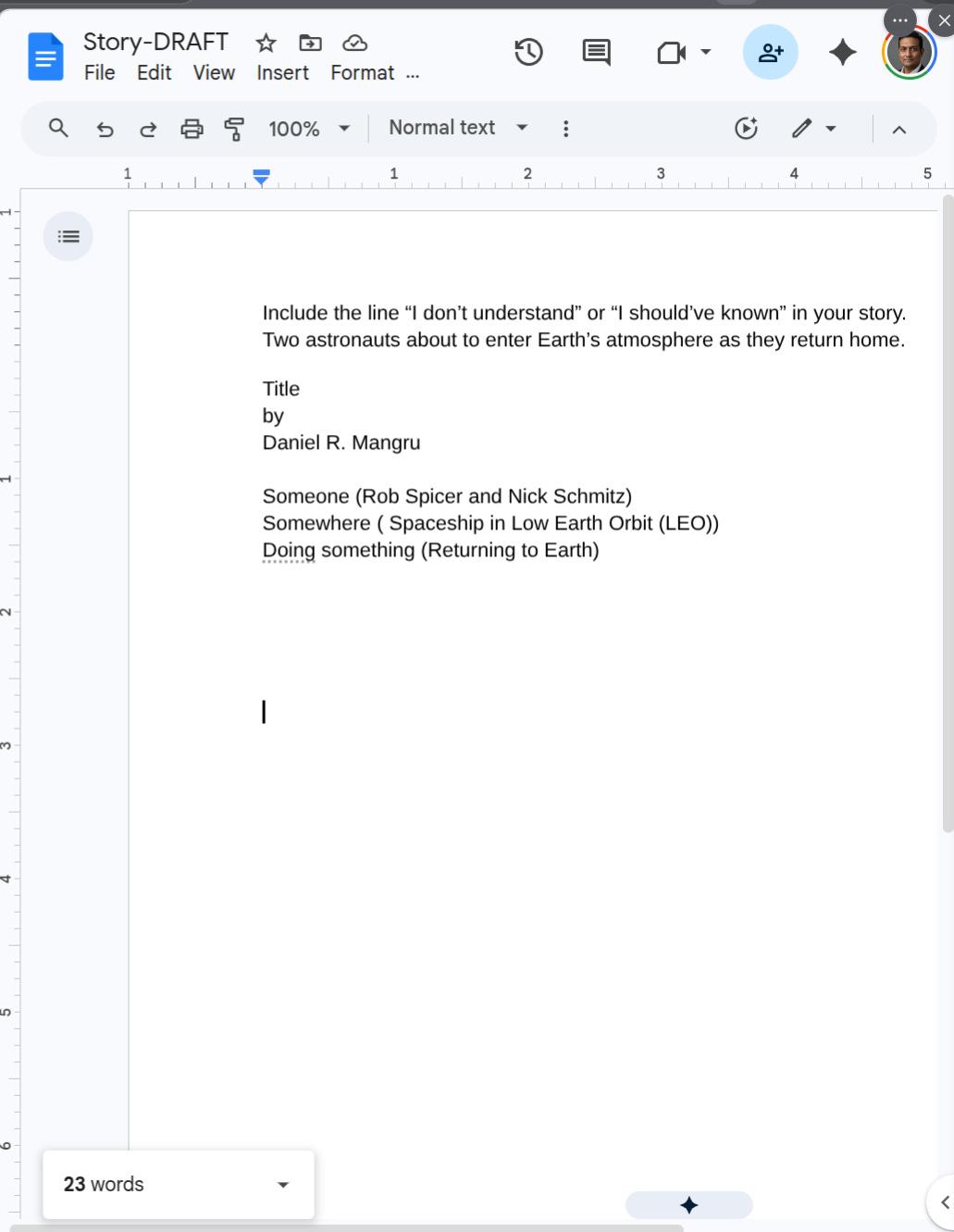
Open a google doc.
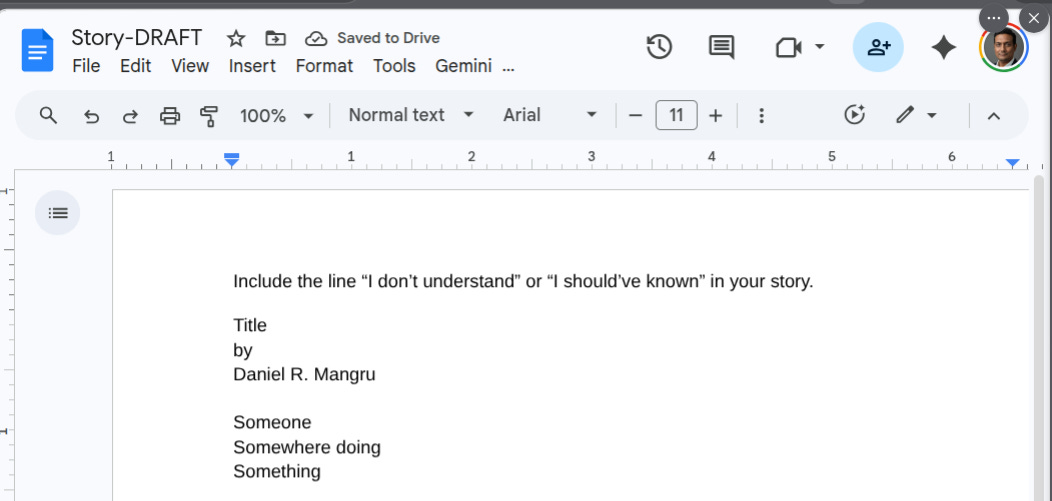
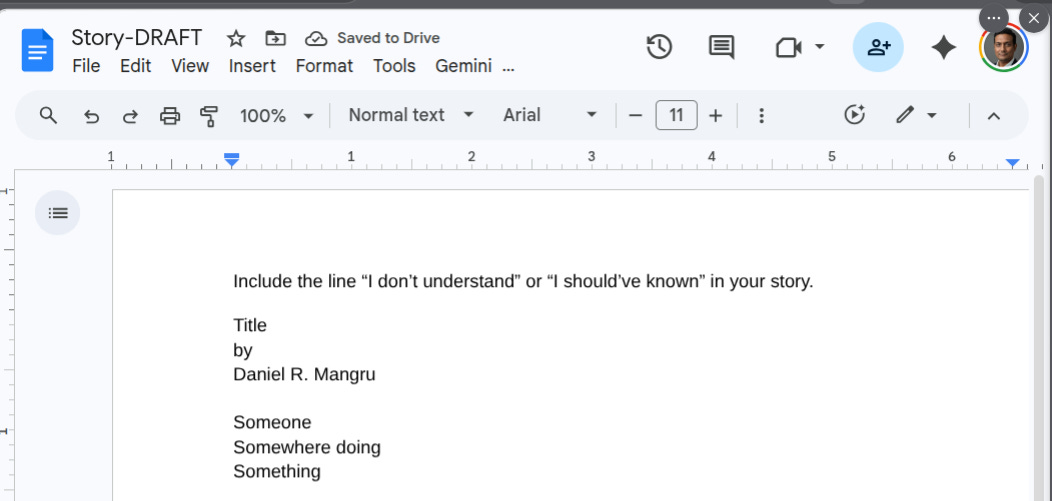
Paste the prompt in the header so it’s always in my face. It’s my North star if I get lost along the way.
Use some placeholder text—see screenshot.
Decision tree / brainstorm.
The text needs to have the phrase, “I don’t understand” or “I should’ve known” and it must be funny.
Random character name - think of last news article I read for someone.
Found this NPR article written by Rob Schmitz and Nick Spicer.
Swap their surnames: Rob Spicer, Nick Schmitz—nice! Now I have two characters.
Place the characters somewhere - look through articles I’ve read earlier for locations. News sources are always good options for different locations where people do wacky stuff. I choose News.Google.com and click on the Science tab.
The Artemis II return to Earth is a big deal. Can I use those quotes? Yes. Now I have two guys in a space capsule.
They have to be doing something compelling enough to draw the reader in.
Recall existing problems with toilet onboard Artemis - frozen urine in pipes. ←too easy, find something else
Found this article about the physical impacts and radiation exposure (BINGO!)
Now I’ve got two people on board a spaceship navigating Earth’s gravity. (Paste this in to my document header) and fill in the placeholder elements (see pic above).
Time Check - Total time spent is less than two minutes. Now the story can go many different ways, but entering LEO is not funny business—which means dark humor will be at play. I have just set the tone.
Countdown to writing with the three ingredients: Someone, somewhere, doing something.
Fact check:
Capsule or shuttle? Orion crew capsule, splashing down in the Pacific Ocean off the California Coast (Yahoo News).
Source Material and a splash of imagination
Changes: Artemis to Zenith IV, 2026 to 2032, 4 crew to 2 crew.
NASA titles are Commander, Pilot, Mission Specialists
Quick math: Looking at my placeholder text, I need to remove 23 words. So wordcount - 23 words = total word count.
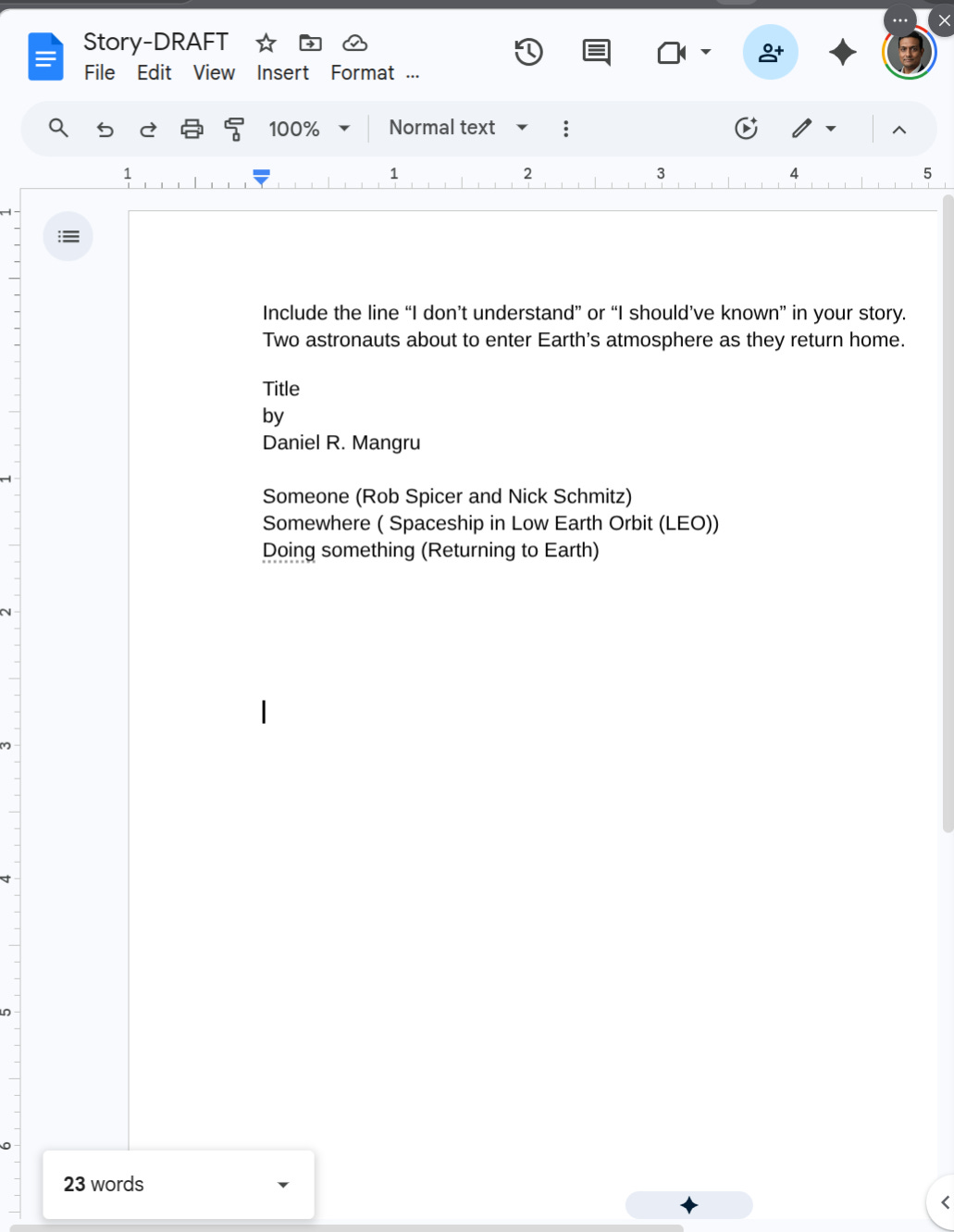
Side note: This is where the writing purists or seminar gurus pop in and say that you need to apply a genre plotting device (Hero’s journey, horror, romance, sci-fi beats) with a character arc, conflict, and more points of failure before the triumphant end to the climax.
I say, nope.
They pivot and call me a pantser or plantser.
No again. I’m a plotter who learned to listen to their characters. I’d say I’m an expert at that. I know where this story is going already and It’s written above. Two guys coming back to Earth and entering Low Earth Orbit. I already know what’s going to happen, how, when and how this story will end because I’ll forego traditional plotting to create simple beats.
I have key beats in my mental roadmap.
Entering LEO
Crew communicates with Houston - status check
Crew have a private conversation about risks and procedures
A quick jab at Houston mission control for the laughs
Begin reentry
A panel flies off, speed picks up, coastline coming up fast.
Dark humor (gallows humor) and a moment of panic,
Backstory 1
Splashdown—a few quips back to Houston Mission Control
Backstory 2
Floating in the ocean—mission accomplished.
2500-3000 words done!
Quick math (23 words on page that need to be removed) see screenshot.
No character sheet aside from names and occupation (astronaut).
Strategy for the opening paragraph:
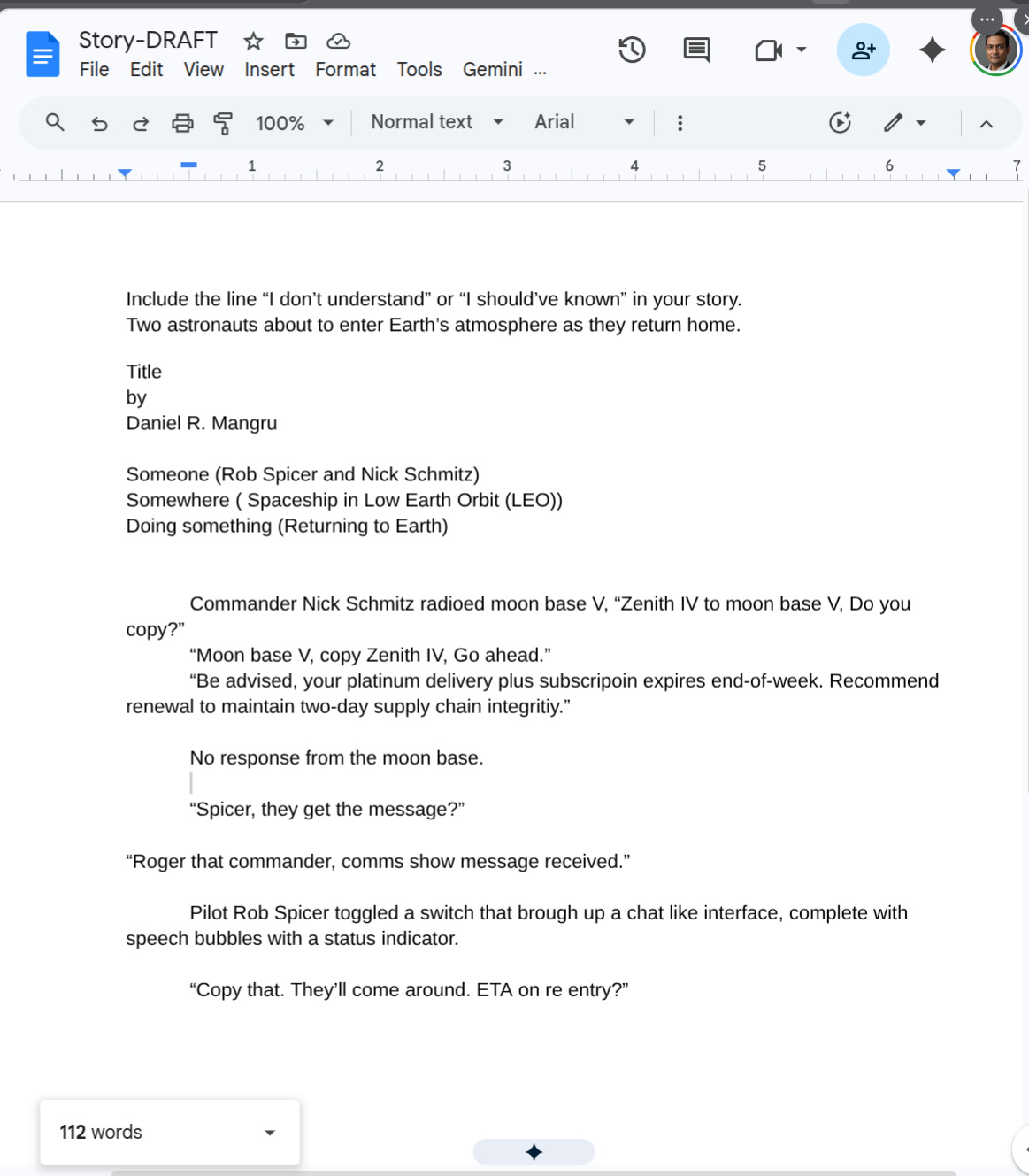
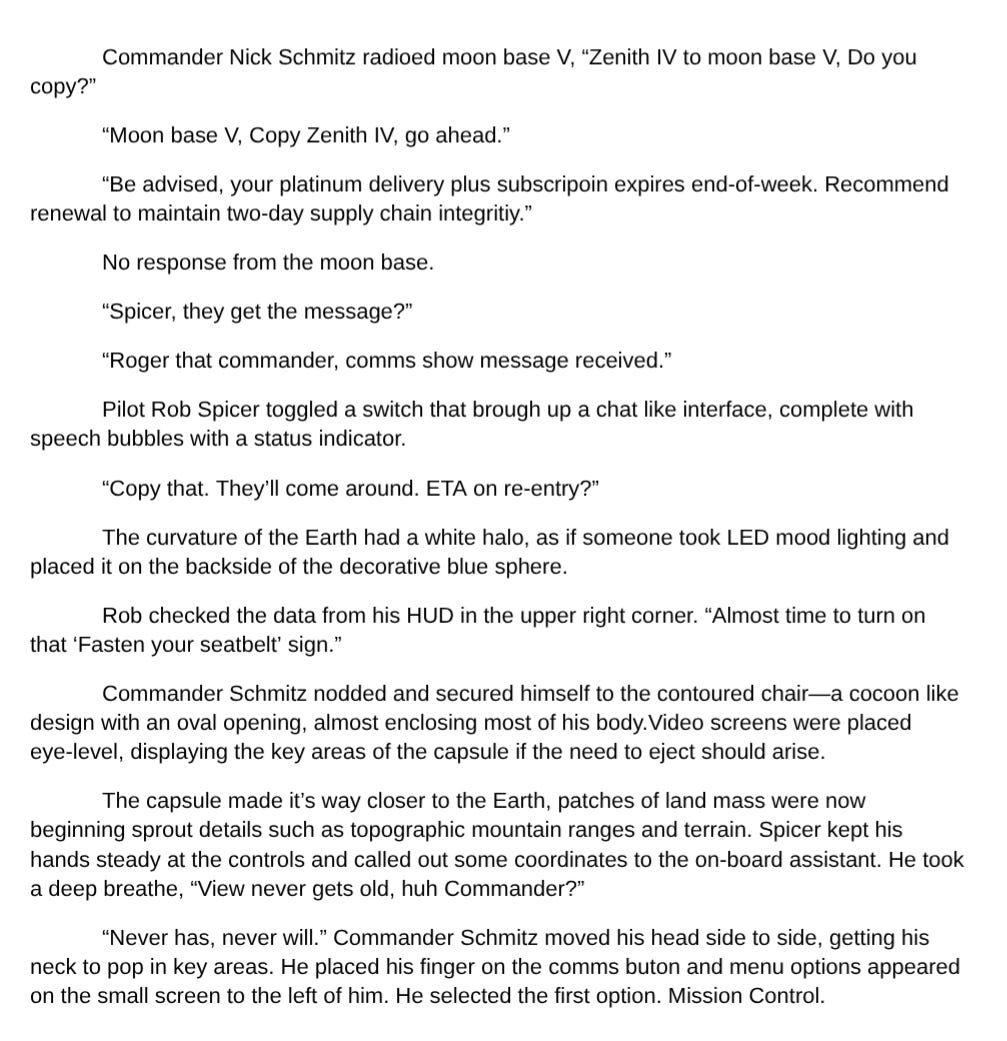
I picked the names randomly, Nick got to be Commander. I need to showcase his personality, so I’m having him radio the moon base for the setup. This does several things:
Establishes technological progress and sets up a timeline—-five moon bases already exist, and two-day delivery from Earth to the Moon is a convenient service offering.
Commander Nick seems eager to continue doing deliveries—which establishes experience, confidence, and a voice as a corporate messenger too, which I’ll contrast in conversations with his pilot Rob Spicer.
The second line: “No response from the moon base,” can be used to position the story in many different ways, horror, comedy, sci-fi, mystery, thriller, and more. This is flexibility on how I can hit my beat and the reader doesn’t know what the story will be genre-wise.
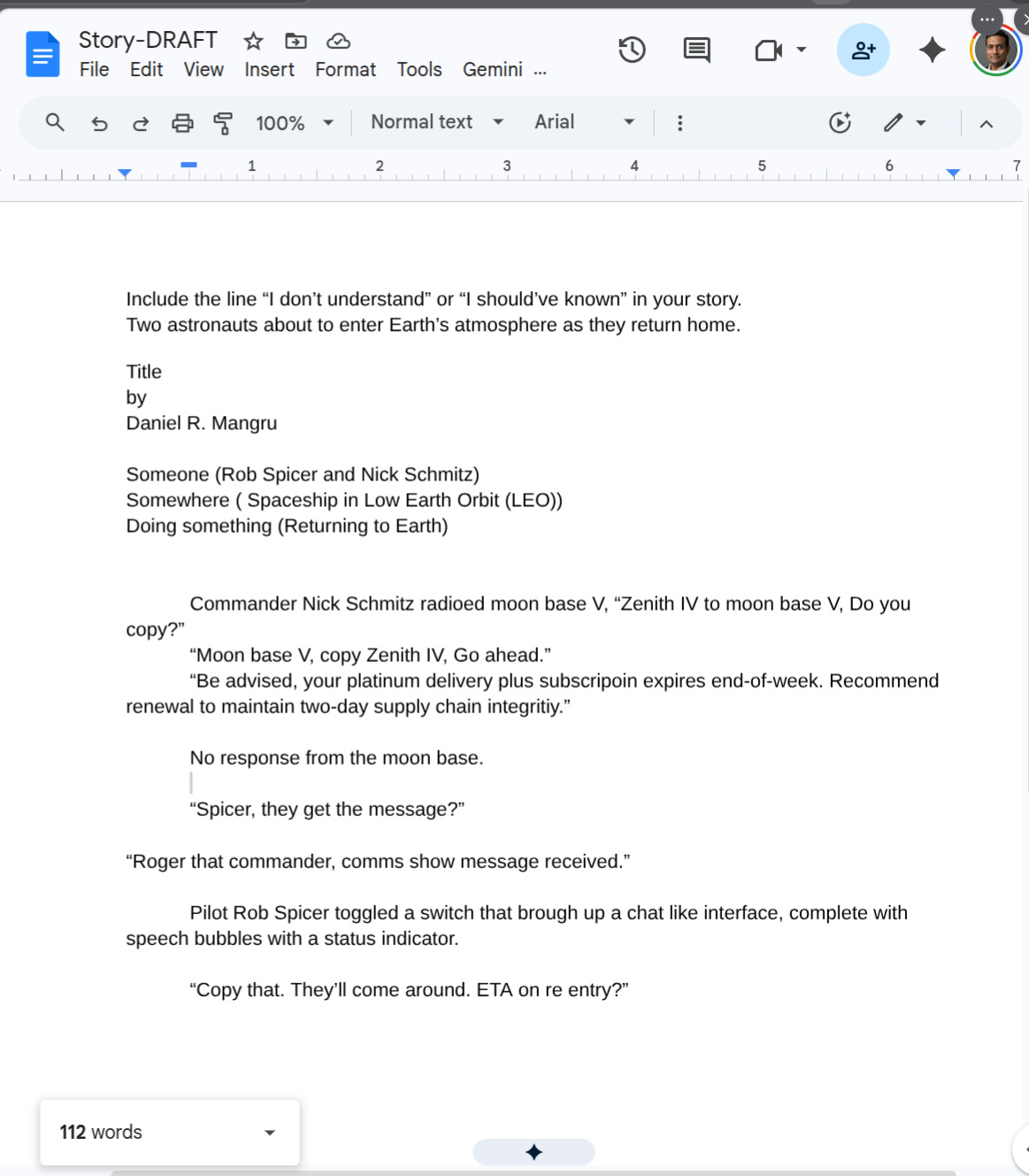
Self-Assessment: Phrasing sounds clunky. Go listen to some NASA Space comms on YouTube.
Edited language for realistic phrasing after 45 minutes of interesting videos. I could have kept going, but research is not writing—-words on screen/paper is writing.
Housekeeping - added first line indent to the formatting so everything is not left aligned at the margins. (see screenshot). This is my bad because I altered my default template for another project.
Content Analysis (opening paragraph audit):
Dialogue should sound authentic now.
Character should be evident - commander is procedural, but also has some snark. Pilot is procedural for now, eyes on safety.
A timeline has been established were Moon missions have evolved with safety in mind, as evidenced by the Commander’s chair.
Pacing is controlled with pertinent and relative data. Manipulating the time stretches with quick punchy dialogue and then long descriptive passages for reflective moments.
We’re about to hit the first beat—The reader doesn’t know what type of story this is yet.
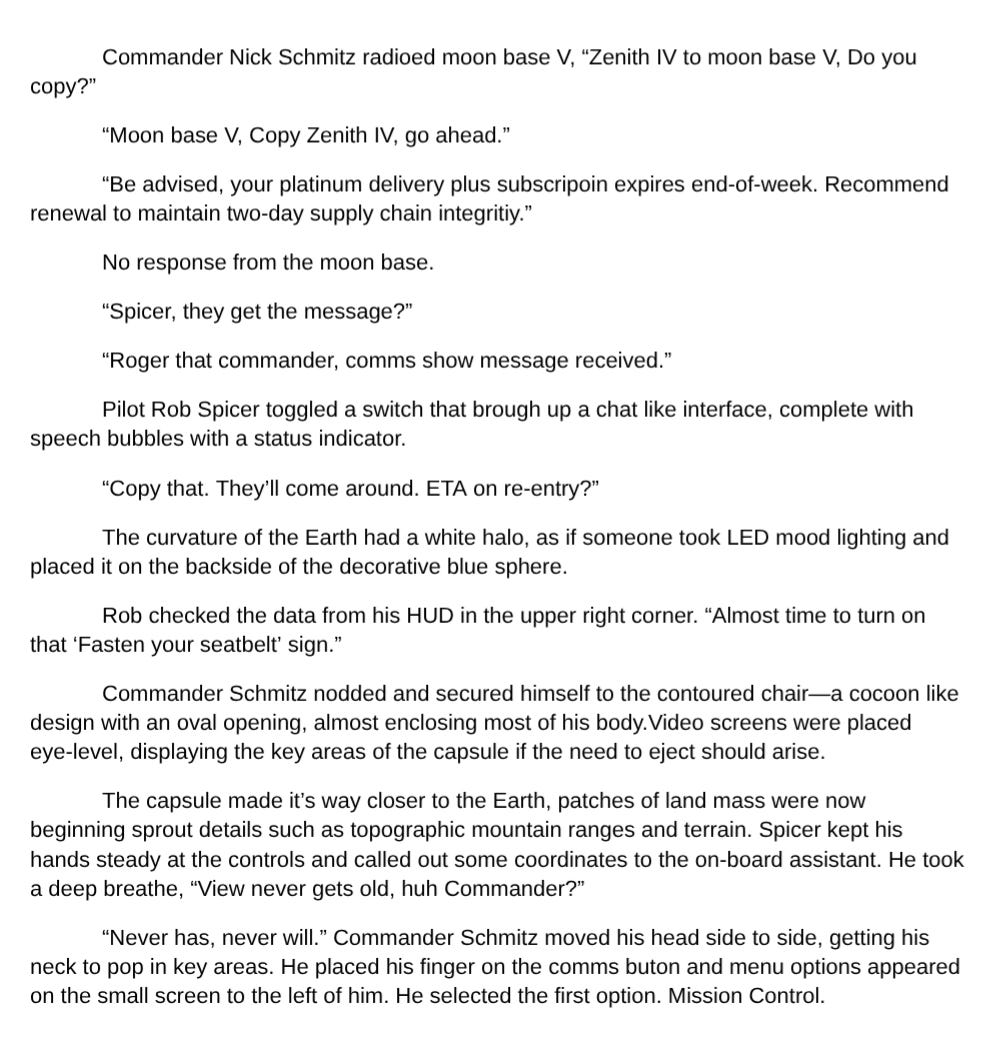
Hit that first beat, feel out the characters, how do they act and how do they respond?
At 619 words, the core story has been setup for a diversion.
The characters are telling me they need to have a bonding moment. Let’s see where this goes.
Spicer voices his concerns about the triviality of the traditional checklists that seem like a relic of past missions from decades ago.
Now we’ve set the stage for any number of bad things to happen:
The lack of Moon Base V’s response from earlier. Is there something wrong with the Moon Base, or are they just tired of corporate speak.
Mission control got over a tense moment, might be too relaxed now for what is about to happen next. Perhaps an astronaut that cried wolf—-scenario?
By stating that there are no longer any radiation issues, it makes the most sense to break that sense of normalcy. ←ding! ding! ding! We have a winner.
The Uh Oh moment
I want this to be the click-click-click before going over the hump on a roller coaster—- and then the drop comes. That’s my roller coaster analogy.
Raise the tension, quicken the pace around the 736-word count.
Options
Put the brakes on the action with two backstory reveals, detailing interior thoughts and memories of both men as they face a possibility of death.
Forego character development to further the action. I’m choosing A because I want to know more about these two.
Change of Scene at 930 words, plenty of room for exploration)
As the two astronauts figure out what to do, ground control is scrambling.
At 1123 words, there is chaos at ground control, let’s check in with our protagonists.
Change of Scene at 1123 words.
Our astronauts now know the procedural book. Is that enough?
We need to know what’ s happening in their head - time to slow things down.
Shit is hitting the fan at 1485. We got Spicer’s backstory and have an emotional stake in his well-being.
Ground Control 1485 words
We leave our astronauts in freefall as we check in with mission control.
Things look grim until two sparkles in the sky appear.
Commander’s Backstory 1732 words
The commander is in a freefall, so this is a good spot for some backstory.
Oh crap, I didn’t think of a name for his wife. Alura seems too cartoony or space-y, Alanis works. Three syllables, good name for poetic prose.
Backstory complete at 1975 words. Plenty of room to bring this story home.
Splashdown commenced.
Nearing the end 2198 words
I’ve told the story I wanted to tell at the beginning. Its time to add the prompts in a way that makes sense.
Okay, at 2375, the prompts have been implemented
Oops! I forgot this was supposed to be a humor piece.
THE END @ 2422 words - 24 placeholder = 2400 words
I closed with dark comedy. Everyone involved from our astronauts to mission control have been on a wild ride.
We start with low key comedy, shift to a very high stakes action sequence, move into dread, and then do an about face pivot for a way back to a dark humor ending.
Parting thoughts:
You have seen my thought process. I think it’s transparent, accessible and it serves an over the shoulder look into my methodology for craft. It’s a large shift from reading rules of writing and trying to make sure a story fits a mold.
This is a character-first story, with humor, then a tragedy, with a triumph, and dark return until closure.
There is no hero’s journey or 17-point plot plan. There is no Stephen King on Writing here, no how-to books. Could you twist yourself into a pretzel pointing out ways it could be? Sure; but my intent was stated up front, and the output is the result of that intent.
The takeaway is this: Start with the most basic elements: someone, somewhere, doing something. that’s it for step 1. Don’t spend too much time on this or you’ll over think it and derail yourself before you’ve hit your stride.
Once you have that, you are the captain of where that vessel goes and what form it takes. At this stage the characters are real, what they’re doing matters, and where they’re at is a centerpiece for now.
Be mindful to put some sensory elements (sight, sounds, touch, taste, etc) and find opportunities to show things in a cinematic way, the way it would appear on the screen.
Pacing is a big thing that I try to explain to people as often as I can. Like poetry, strategic line breaks help the beat land at the right moment. You can see it in action from the speed of the ups and downs and where I take forward momentum and time-dilate it.
Is this easy: I think so. I love the process and I do this weekly if not daily sometimes. The difference is that I’ve been doing this in long form with pen and college ruled binder paper since sixth grade. The change is that I know the terms and a few technical niceties, but the ore device of crafting a story and letting the characters come to life has not changed in millennia.
You do not need a Character sheet of 125 traits filled out before you start or knowing what type of pizza they’d order. You don’t need formulaic templates. You could, but then you lose a touch of authenticity, tone—your voice. That’s a big deal for me. I listen to people talk, which is so interesting, regional, and unique in many ways, but when they write something, it’s all bland westernized wet noodles, because of the way it’s ‘supposed’ to be—yuck!
Write in your authentic self and that will penetrate and linger in the afterthought of your reader and pop up in the future when they least expect it.
Closing it out
The total write time for this is roughly 6 hours, with bio and food breaks scattered about, in reality its only 4 hours, with at least 45 minutes of watching NASA Youtube Videos to see how they speak.
Here is a link to the original document. All human, including my its–it’s corrections: https://docs.google.com/document/d/1o-DNqPZ1fw-VV5Njlsn8S_QyPBk2WCr6d2YmSc6PMbs/edit?usp=sharing
Remember, this is just my process, and it fits me. I’m only one guy, and I’m curious as to your thoughts, and how you write.
Perhaps you can share your #Write-Along in the comments?